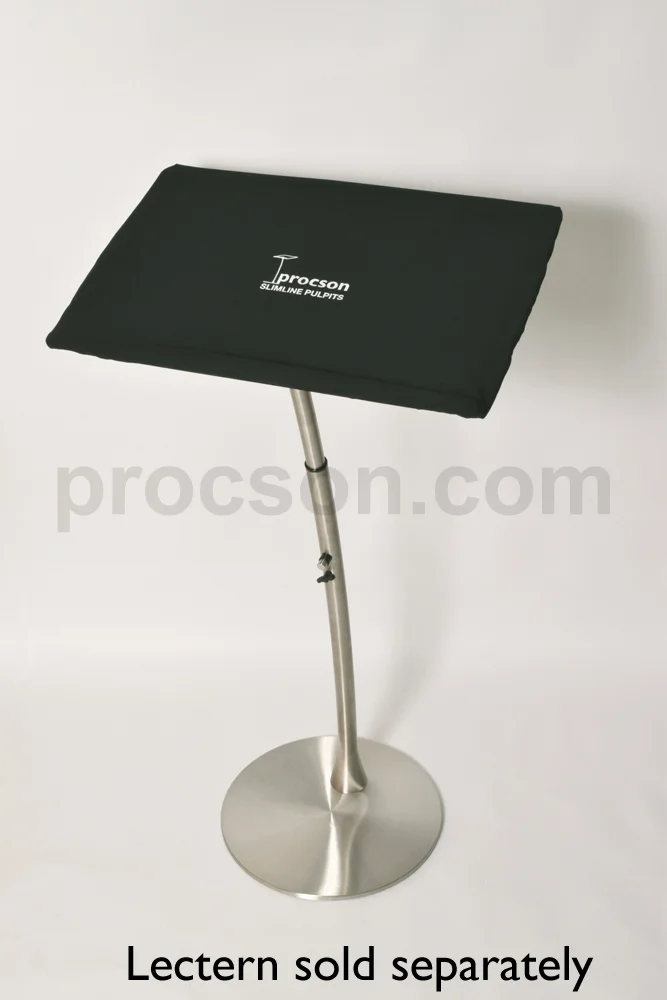




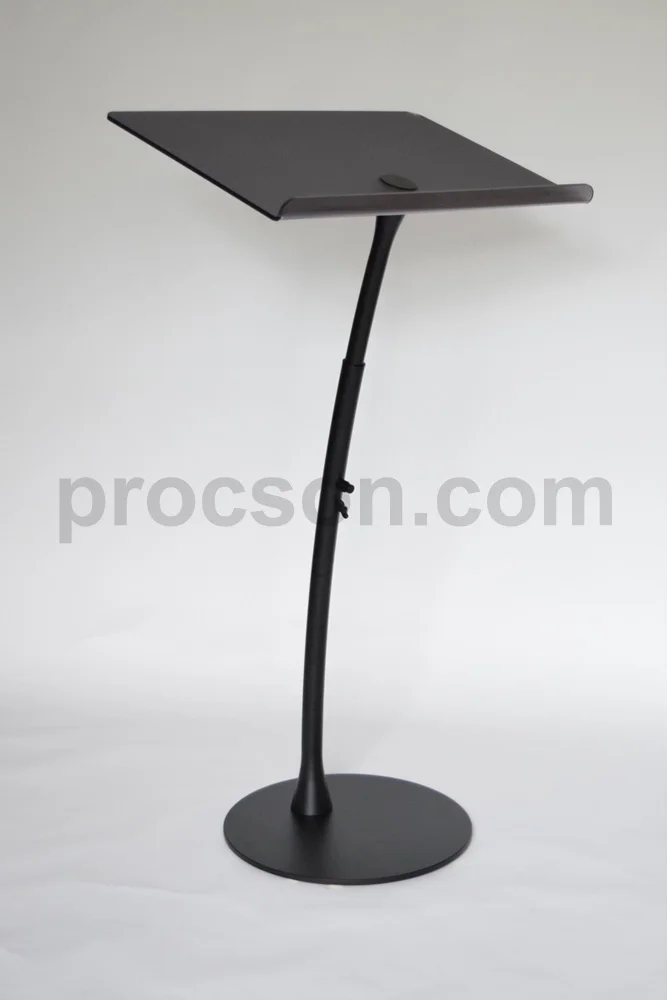
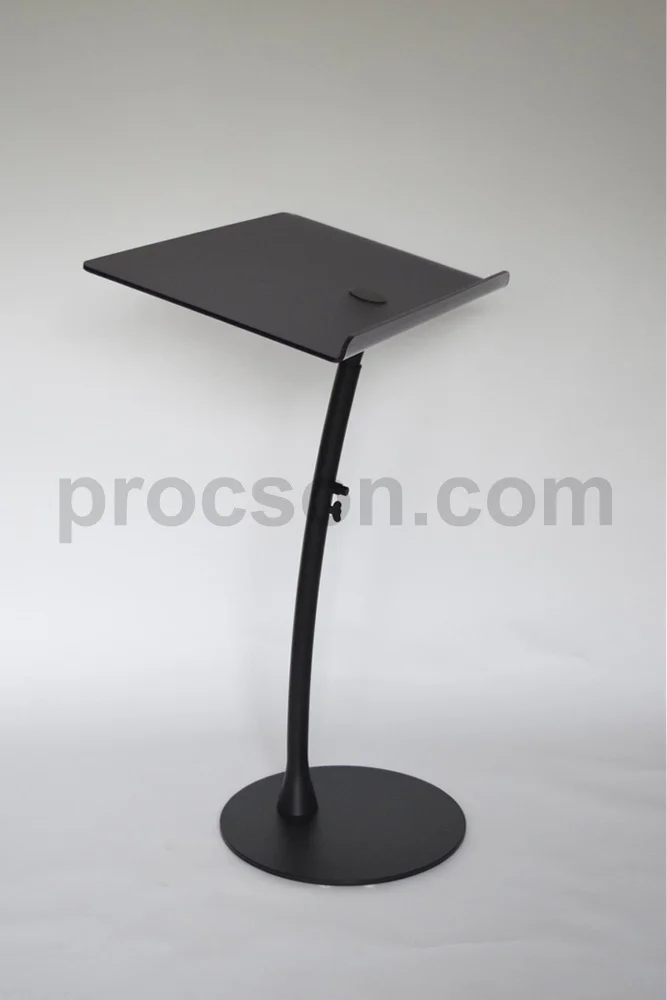
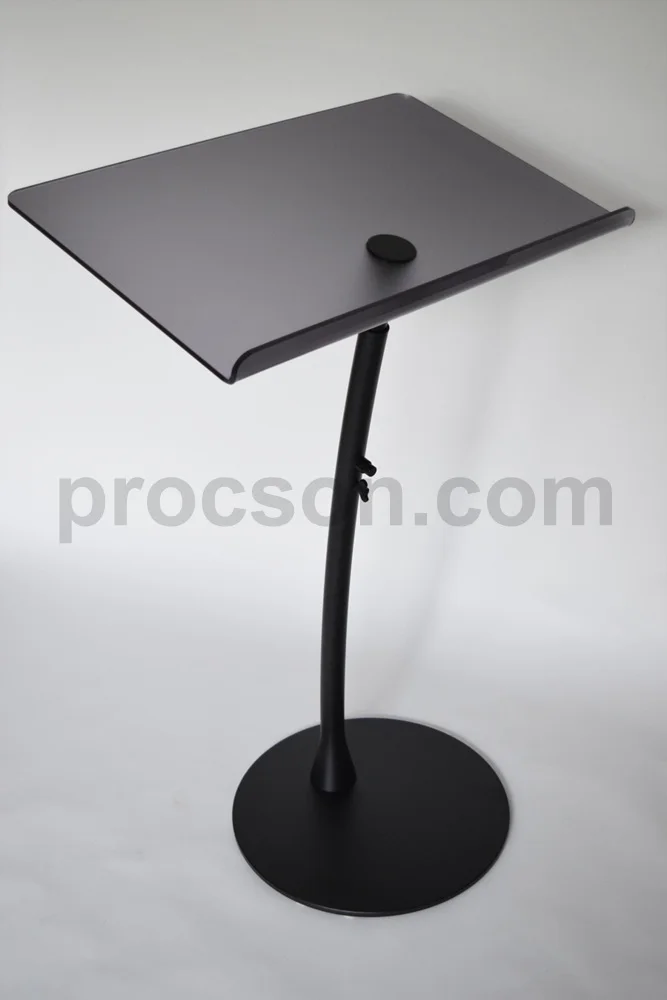
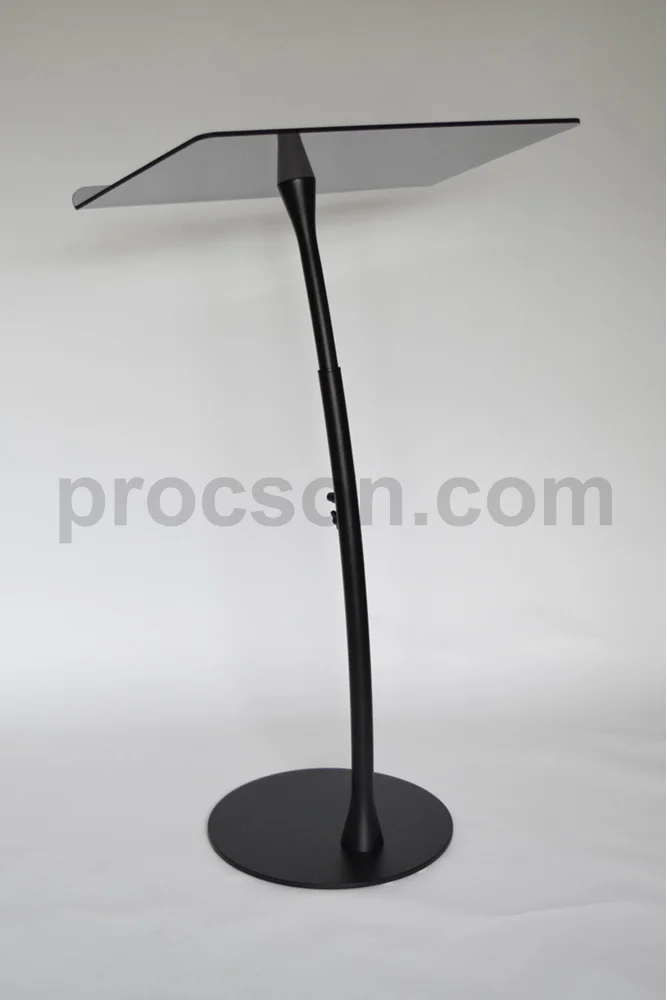
Arc2 Black
Adjustable Pulpit NZD 1,900
- Top Size 70cm (28") wide
- Adjustable height
- Anti glare top
- Stability Rating 8/10
Adjustable lectern
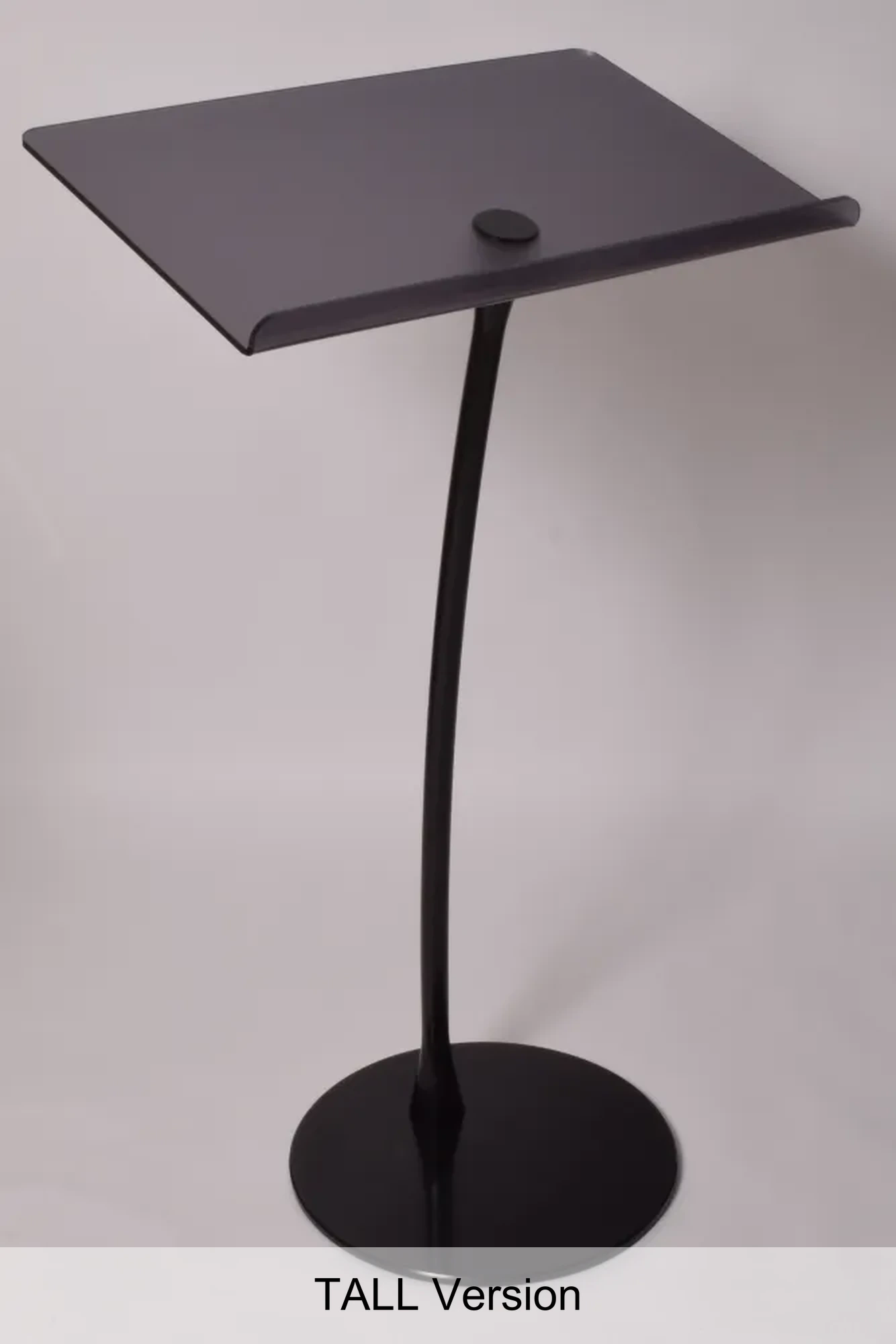
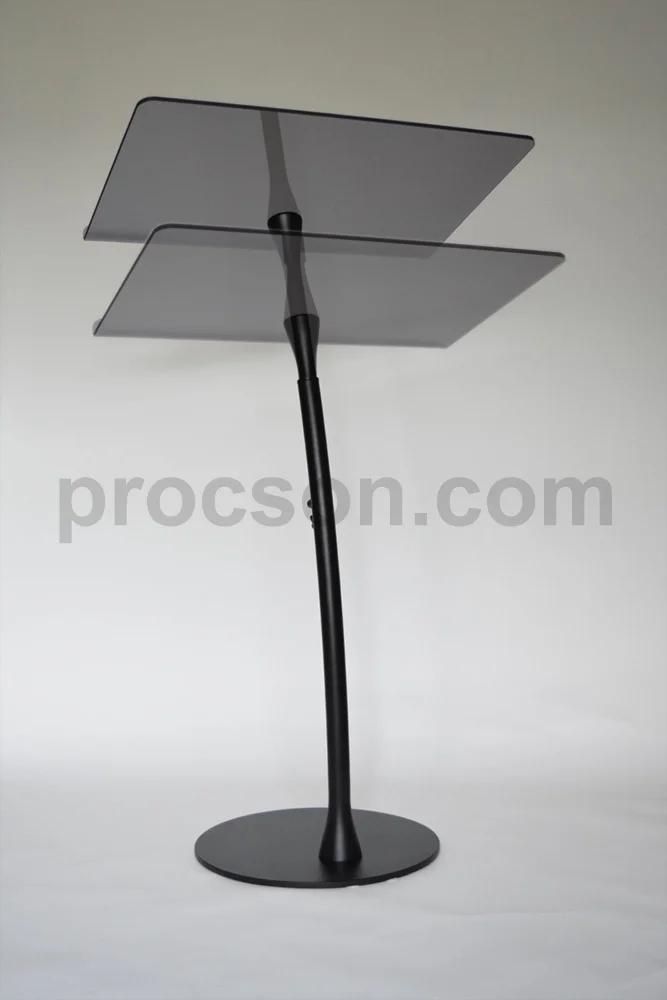
The Black Arc2 lectern
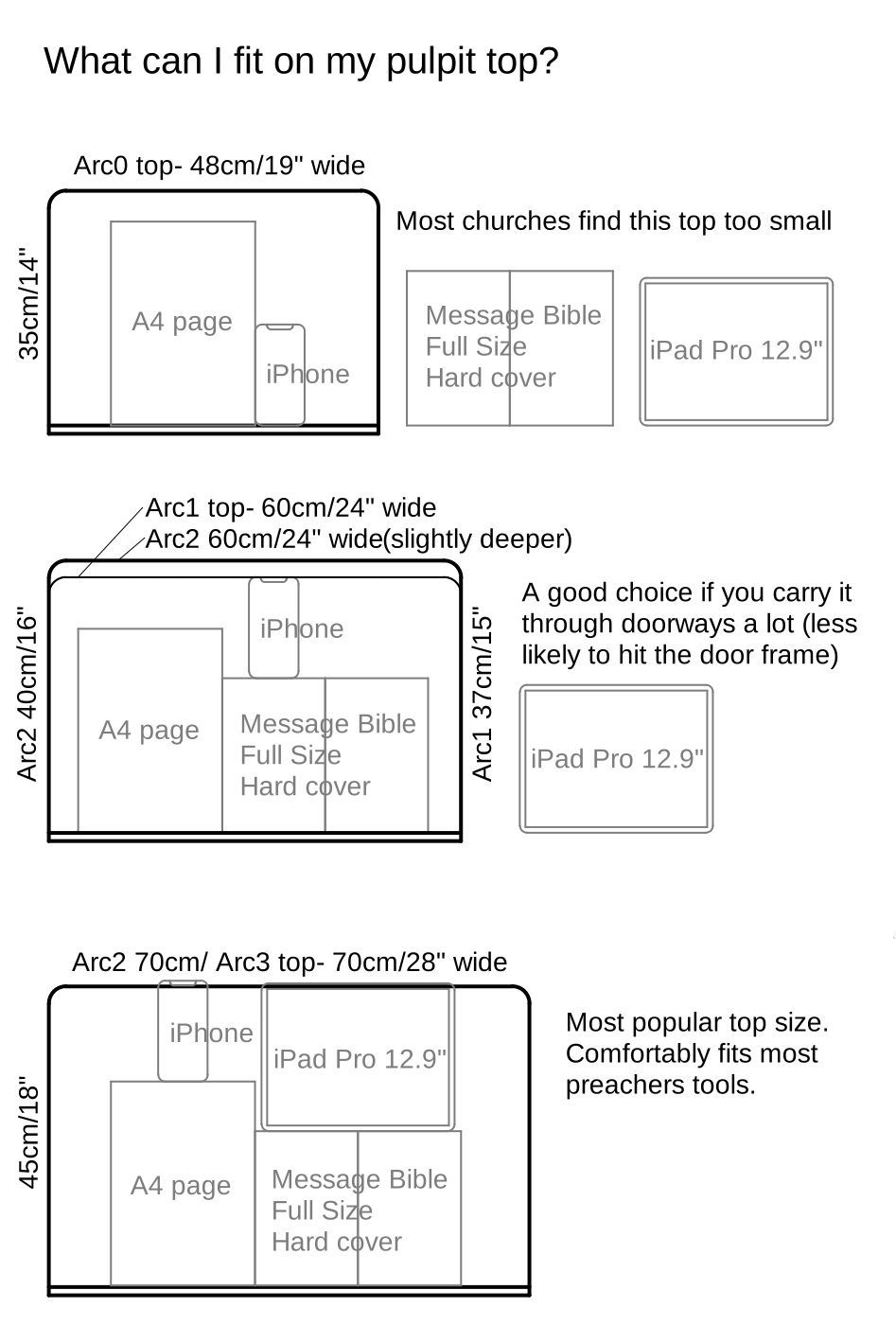
This is the most popular size. If you have your own permanent building (you don't need to bump in and out), we recommend this.
It is large enough to comfortably fit an open A4 folder next to a bible. This top is 45cm deep.
Some preachers find this helpful because they can slide notes or bible away from them to make it easier for their eyesight to focus on.
The top is more flat than say a music stand that is angled more upright. We make it like this so that the angle is both comfortable for looking at while standing, and also so that a bible will not slide back down. This means that you can slide a leather covered bible up towards the top edge and it will not slide down again. If you are using something that is slippery — for example a paper notepad, you can stick small clear kitchen door bump ons onto the top to help keep it in place.
This is a good size if you need to move the pulpit around a lot through doorways (a regular doorway is only 80cm wide so you need to be careful if the pulpit is 70cm wide).
If you need to transport the pulpit, a good tip is to put it across the back seat of a car. Put the centre seatbelt over the stem to keep it in place.
Most churches find this too small. It is mainly purchased by businesses for occasional use.
For example we have made 80cm (32") and 36" wide tops.
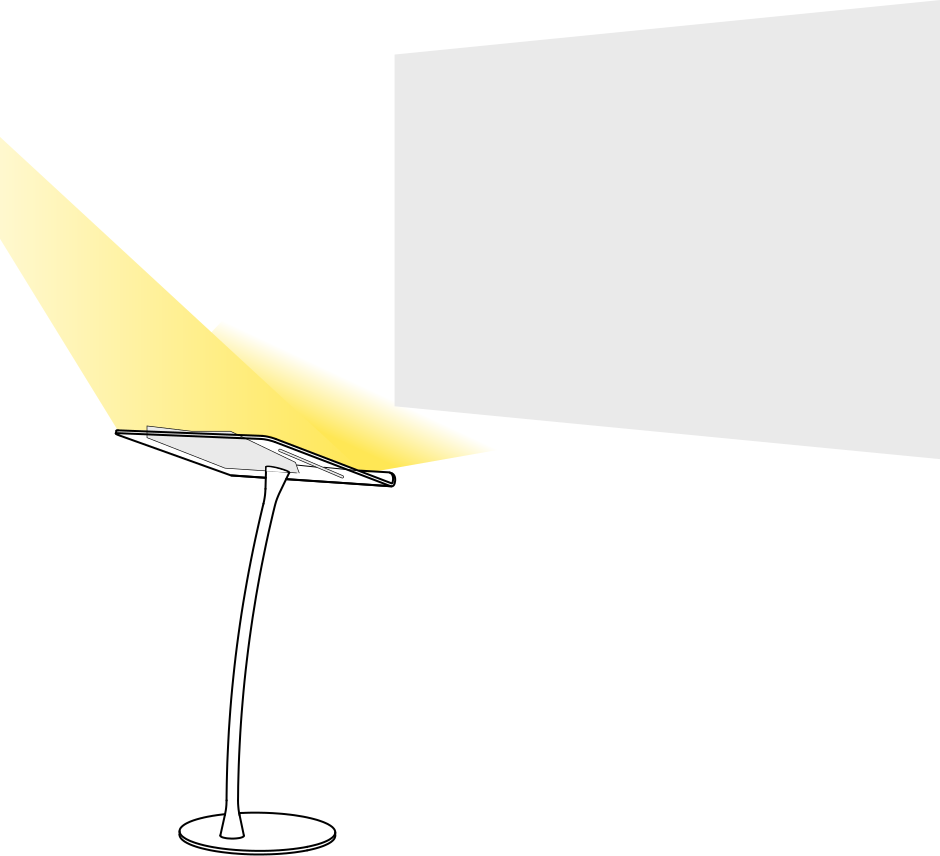
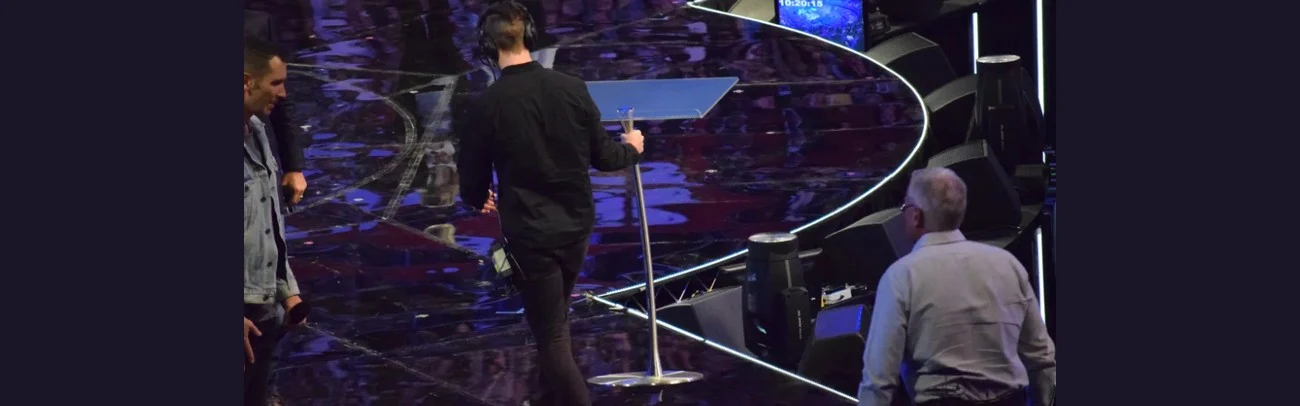
No reflections onto your back wall/projector screen.
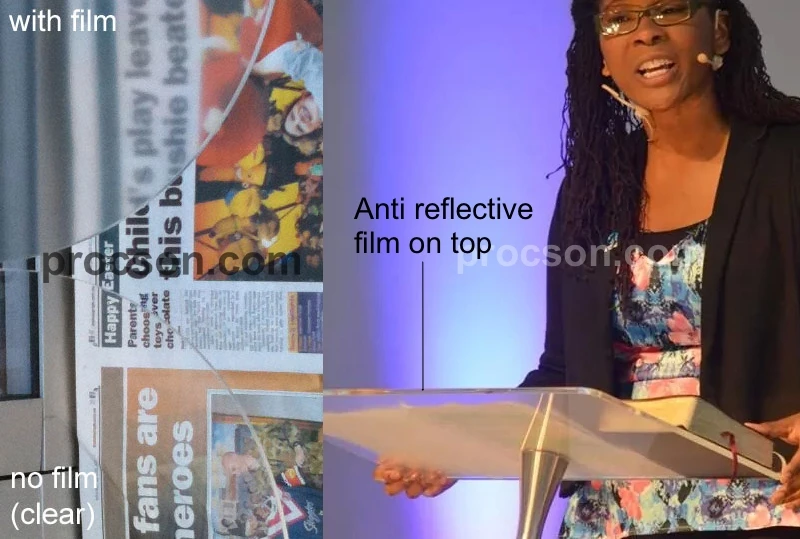
All about anti glare film
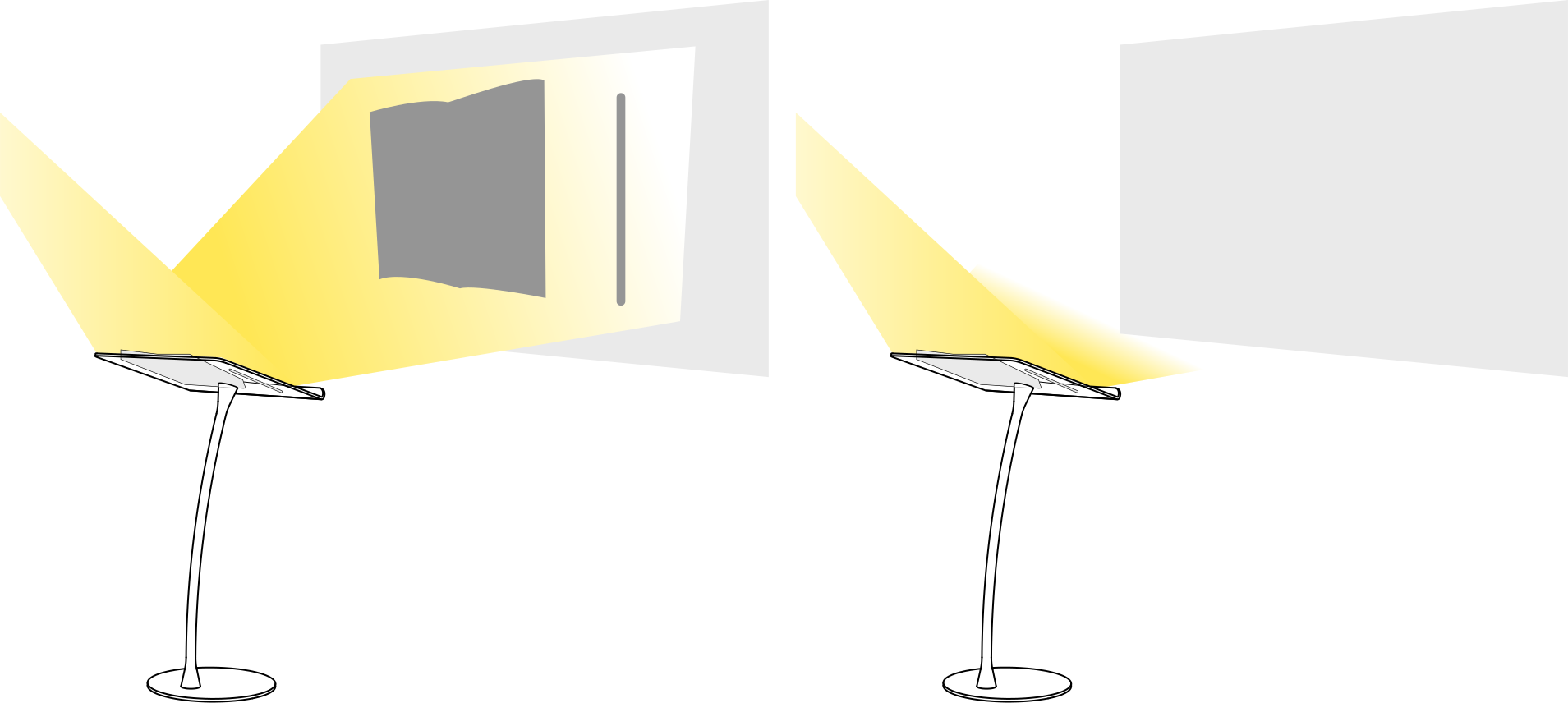
No anti glare film
Stage lights reflect off the pulpit top. Shadows of your bible and pen may be seen on your projector screen/ back wall.
Anti glare film/ finish on top
No reflections onto your back wall/ projector screen.
Anti glare film is mostly needed if there is a projector screen behind the preacher. In this case, lights from above the stage reflect off the lectern top and onto the projector screen.
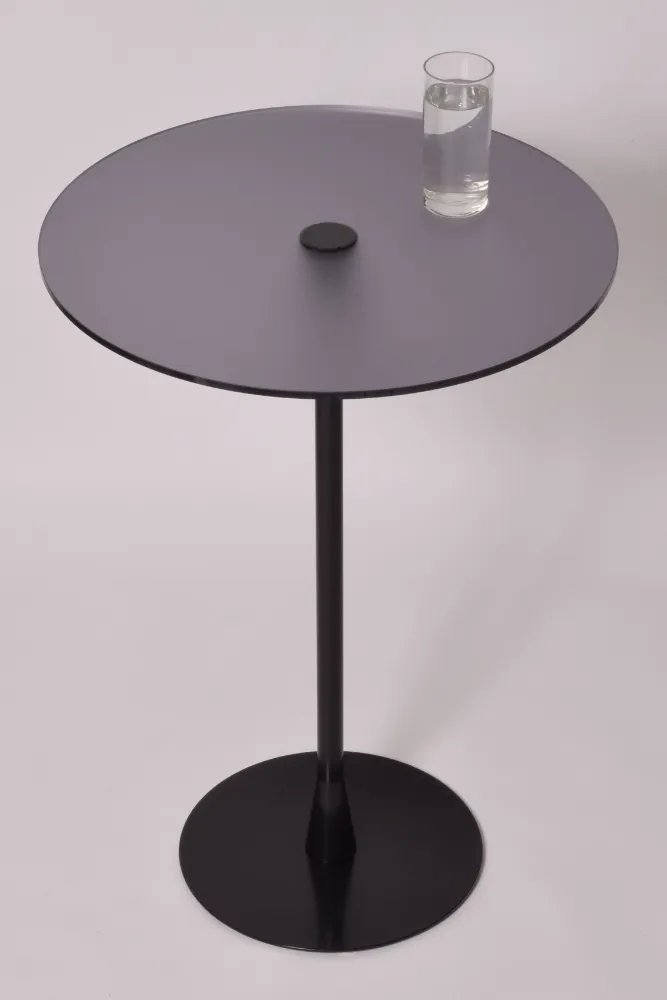
You can test for this by turning on your stage lights and holding something flat and reflective like a picture frame with a piece of glass in it, or a mirror. Hold it where the lectern top would be. If you get unsightly reflections, you need the film. If you need it for the pulpit, you almost certainly need it for the water table as well.
The film is applied during manufacture. It is very difficult to do well. We use special machinery to apply it, and even then there are over 55% rejects.
If you don't order the film, but after receiving your pulpit/ table discover you need it, all is not lost, we will let you know the specification and you can get it applied locally (but it probably wont be done to the quality level we are able to do)
This looks clear like a window. Acts like a mirror and reflects stage lighting onto a back wall or screen.
The anti glare finish is a light texture on the top face of the acrylic. This is particularly important if you have a projector screen behind the preacher (most churches do).
The acrylic is partly see-through. We tested various levels of transparency to get the best result. We found this to be a much more appealing finish than opaque black. You can see the shapes and shadows of items on the pulpit top, but not the detail. This acrylic is custom made for us (we buy a lot each time).
The underside is glossy. We don't have texture on the underside because that makes the top too opaque — does not look very good. This glossy underside can reflect the stage, and at certain angles can even reflect the speaker's legs. This sounds worse than it is however. Because of the low angle of the pulpit top, you have to be sitting low down for this to be a problem. We can apply film to the underside of the pulpit top, but this is extremely rare.
I remember when my own church (Hillsong city campus) first used a pulpit that I had made. The stage lights reflected off the top and straight onto the projector screen at the back of the stage. Every time the speaker moved something on the pulpit top, large shadows moved across the projector screen.
It was so distracting. I was very embarrassed. I didn't listen to a word the preacher said. I sank lower and lower in my seat. I couldn't wait for it to end. The next week I set to work. I got hold of all possible films and tried them out on lectern tops. I wanted to find film that was as transparent as possible, but yet stopped the reflection of stage lights. Applying the film was very difficult. I had to do it many times. Even then, there were bubbles and imperfections. Over the years we improved the process. Now we use a custom built machine and have a dedicated dust free room.
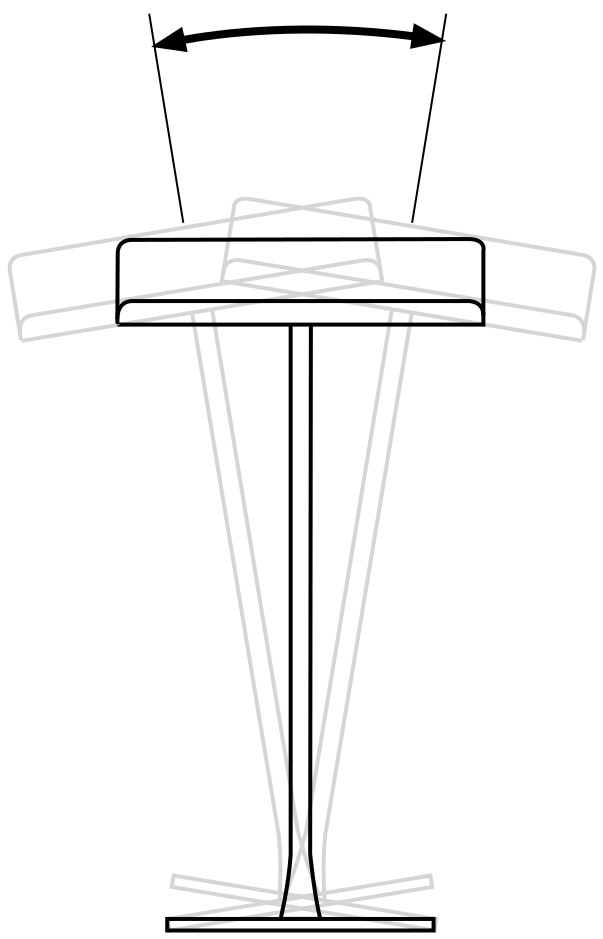
How stable is the church pulpit?
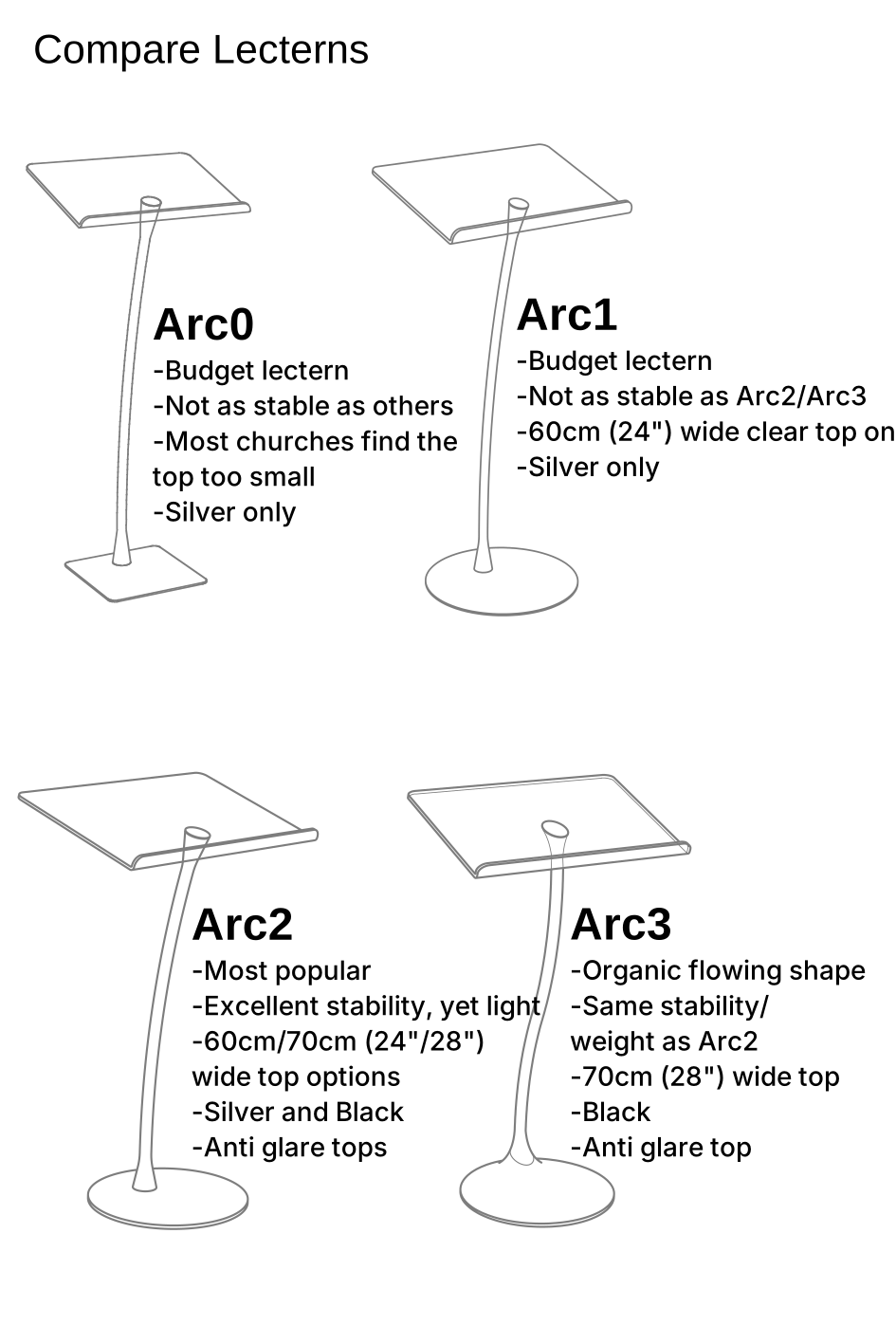
The Arc2 and the Arc3 have a better combination of stability and low weight than the Arc0 and Arc1. If you can get the Arc2 or Arc3, you will never feel like you need to upgrade.
We do a stability test called the ‘nodding dog test’. This is a 0.26kg object dropped from 30cm high towards the lip of the pulpit and then we test how long the pulpit takes to come to a rest. In this the Arc2 (and Arc3) takes 2.3 x longer to come to a rest than the Arc1.
We were not happy with the stability of the Arc1 pulpit and thought we could do better. It is easy to make something more stable if we make it heavier, but we did not want to increase the weight (we want you to be able to lift it with one hand). We made bases, stems and tops in different materials and thicknesses. We made 34 prototypes. We tested and tested and came up with the best combination. That became the Arc2. The Arc3 uses the same improvements as the Arc2.
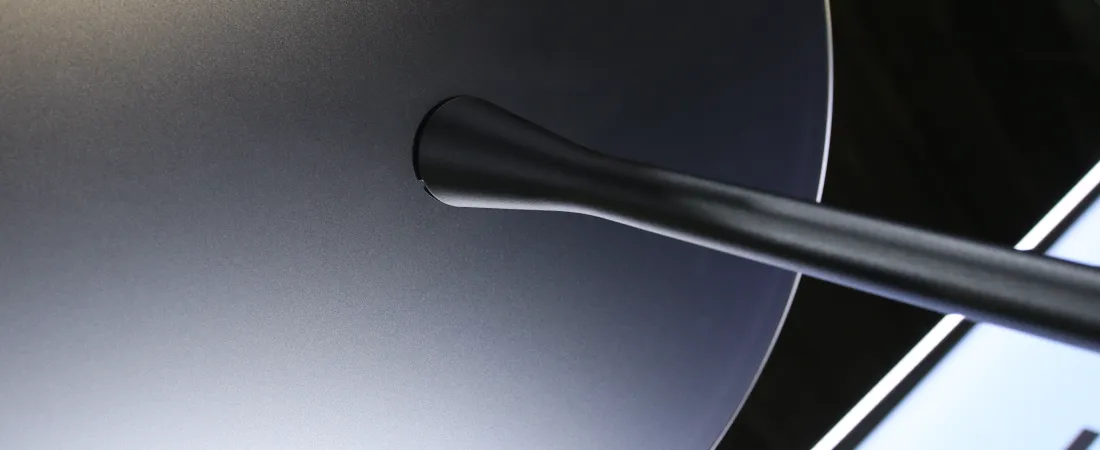
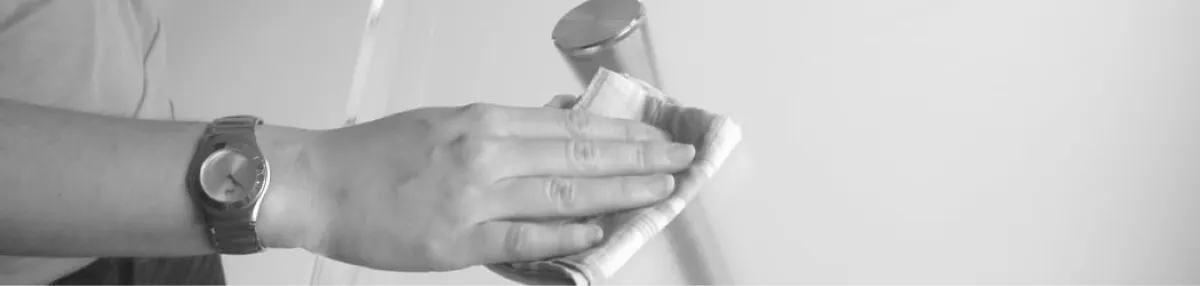
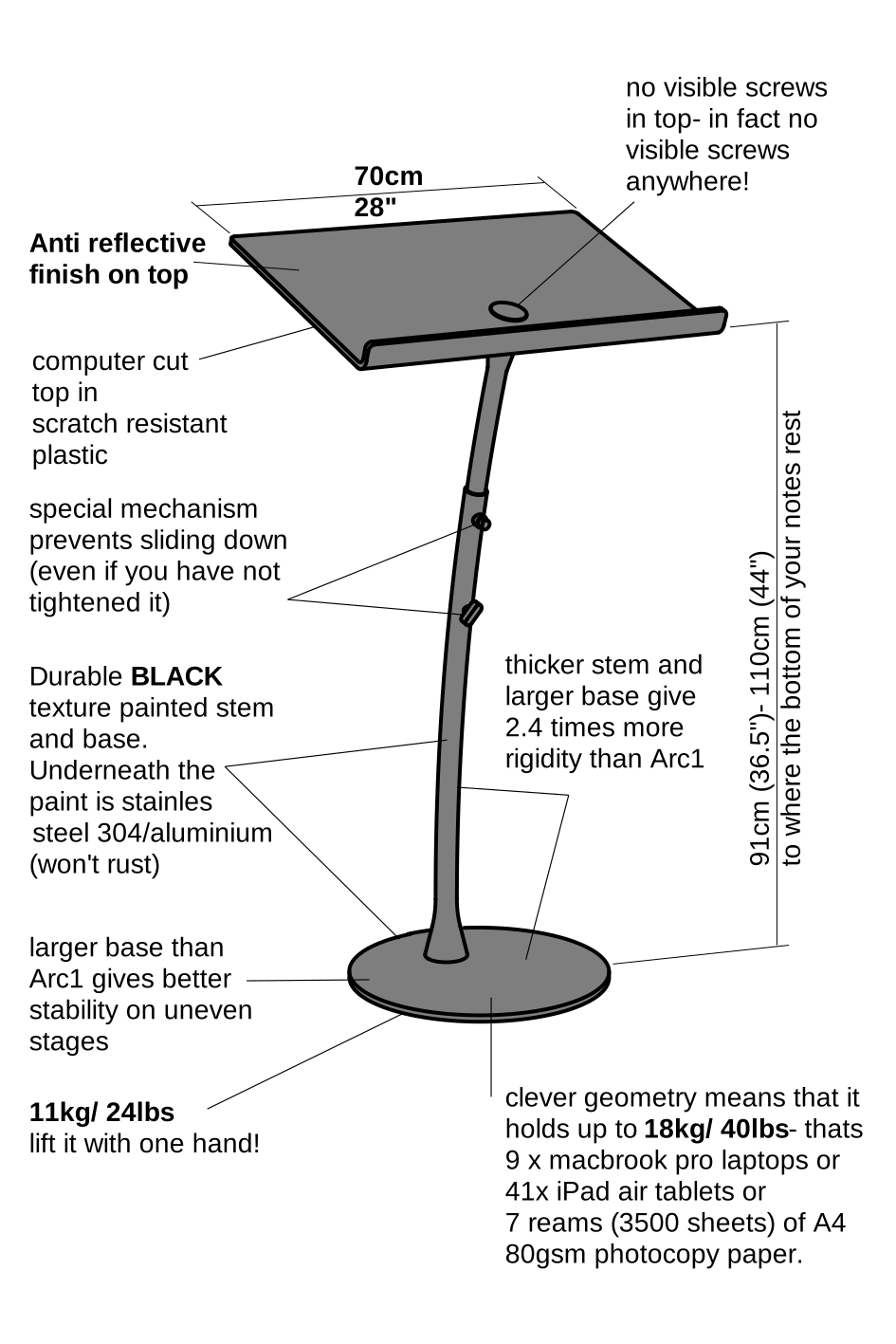
This is a durable finish that is baked on. The texture finish has 2 advantages: it is more difficult to scratch, and it has a modern matt appearance.
Underneath the black texture paint is stainless steel. One of the problems with painted finishes on regular steel, is that the steel can rust, making the paint flake. Stainless steel will not rust, so this will not happen. It's much more expensive for us to make it this way, but we want your church pulpit to last.
If you do manage to make a scratch in the paint: touch it up using a sharpie marker, or use a technique taught to me by a veteran kitchen maker: fold a piece of paper diagonally so it forms a point, spray some black paint onto a piece of plastic, dip the paper corner in the paint and dab the area that needs fixing.
Acrylic is the most scratch resistant clear plastic (while polycarbonate is more bullet proof, amazingly it scratches easily!). Acrylic can break. We keep replacement tops if this happens.
So that your pulpit will not lean left or right. It will also have the correct curve.
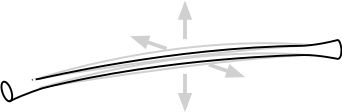
The spring back of each piece of stainless steel is different. Stainless steel also warps slightly when it is welded.
This means that after manufacture, every stem needs to be carefully manipulated to make it just right. This is done by a skilled technician using machines that we have made ourselves.
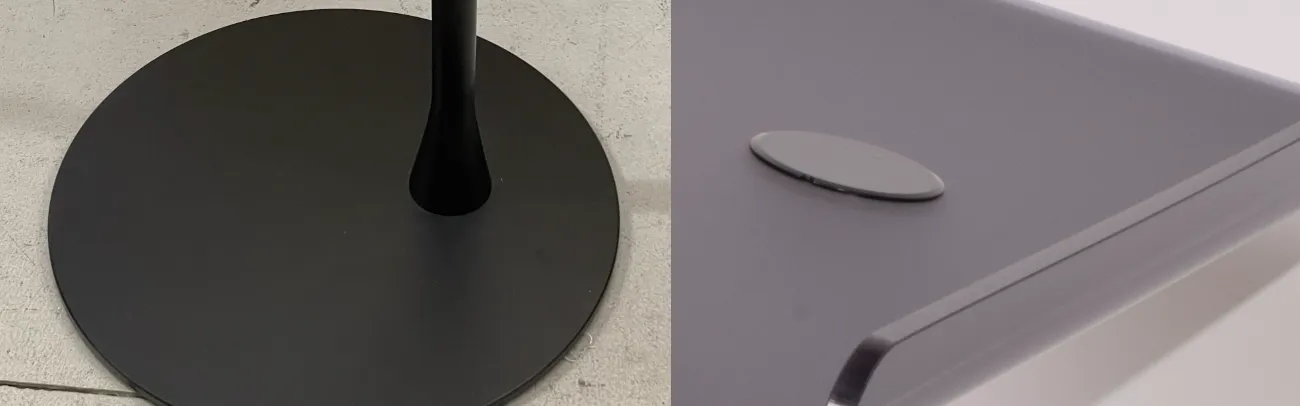
Shapes like circles, cones and rectangles are familiar. They are the shapes we learnt in geometry at school. They give a sense of timeless design, that always feels modern.
Minimalist design makes sense to our minds. It is design where the shape is as simple as possible. Nothing needs to be added, and nothing can be taken away.
The Arc0, Arc1 and Arc2 use 'formal' shapes like circles, rectangles, cones. Used well, these have a timeless appeal, particularly when made well in a high quality material like stainless steel.
A good example is architectural looking bathroom taps, hand rails and door handles like those made by the Danish company d line. Many of these designs are from the 1950's but they still seem modern.
The Arc3 is the best pulpit we make. Why? Like the Arc2, it is sturdy and yet light enough to be lifted with one hand. Unlike the Arc2, the Arc3 has a more flowing and modern shape.
The Arc2 has geometric shapes, like circles, rectangles and cones. The Arc3 uses elliptical and streamlined shapes. These are often called organic shapes. For example, the shape of the stem flows smoothly into the base.
Of course it's more difficult to make a fluid organic shape like this. We were told it was impossible to make.

Poppy has just finished polishing bases
Brad countersinks a table base
Although it looks simple, it's complicated to make well. There is a lot of craft involved. It requires our own custom made machines and special set ups. It requires constant checking to make sure everything is done correctly. That's why we make it in our own factory (and some outside using engineers with specialised machines).
You may have read some of the trials and problems we have overcome in making our pulpits. You can imagine it is not possible to just pass this knowledge onto someone in a far away country and expect them to make it for us.
That's why we make them ourselves, and we make them here. So that we can do it properly. So that every day we can try to make them a bit better, a bit more efficiently.
A lot is said about cheap labour costs in other countries, but from experience we have found that if we just concentrate on a process and make it more and more efficient, we can do it so that the labour cost is reduced to a point where it doesn't matter that we are paying high wages.
We also see them at our churches on the weekend. That keeps us accountable.
Gob smacked!
“Everyone was delighted - or as our Pastor said, 'Gob smacked!'”
Julie Schultz, Children's Pastor, Hills New Life Centre, Mt Barker, SA, Australia
It fits so well
“The lectern arrived last Friday afternoon as you said it would. It looks really great in our new auditorium. It fits so well and Andrew is really pleased with it and the table too.”
Corinne Hartshorn, Office Manager, Rangeville Community Church, Toowoomba, QLD, Australia

Top: within 1 year, half price replacement.
Stem and base: 1 year.
Returns: buyer pays return shipping.
If you break a top within 12 months (unlikely), the replacement top is half price. Stem and base warranty 12 months. We expect you will use this for 20 years.
Returns — buyer pays return freight. We have a very low return rate however — about 1 in 1500. (Most problems occur when a church orders a pulpit that is too tall / too short / top is too big or too small). These are often solved by just sending a new part rather than needing to return the whole thing. We are a small family company, so we are flexible.
Please look at the dimensions on our website and use a tape measure to check the size before you go ahead.

The challenge of getting curved tubes to slide within one another proved to be more difficult than we expected. The idea seemed simple — 2 tubes bent to the same curve, with an adjustment mechanism. However, it turned out to be difficult. It's the alignment that's the problem. Making a straight stem that adjusts is easy. Making a curved stem that adjusts is something completely different. At each stop point, everything has to align perfectly. Otherwise the lectern top will tilt slightly to the side. Many of our lecterns are used on TV, so we couldn't have it tilting slightly.
We tried method after method. Finally we ended up with a process that uses 7 welding jigs, and 5 alignment jigs (a jig is a purpose made brace with all sorts of clamps to align something). The stems go back and forth 5 times across Sydney — while each process is done by us and our specialists. So it all looks simple in the end. But the process of getting there is not simple. Even after all our efforts, it is a long assembly process by a skilled technician. Every stem requires individual fine adjustments to make it fit and align properly. Each inner and outer stem are matched carefully together by hand. After this it goes though an alignment check to make sure it aligns correctly at each height position.
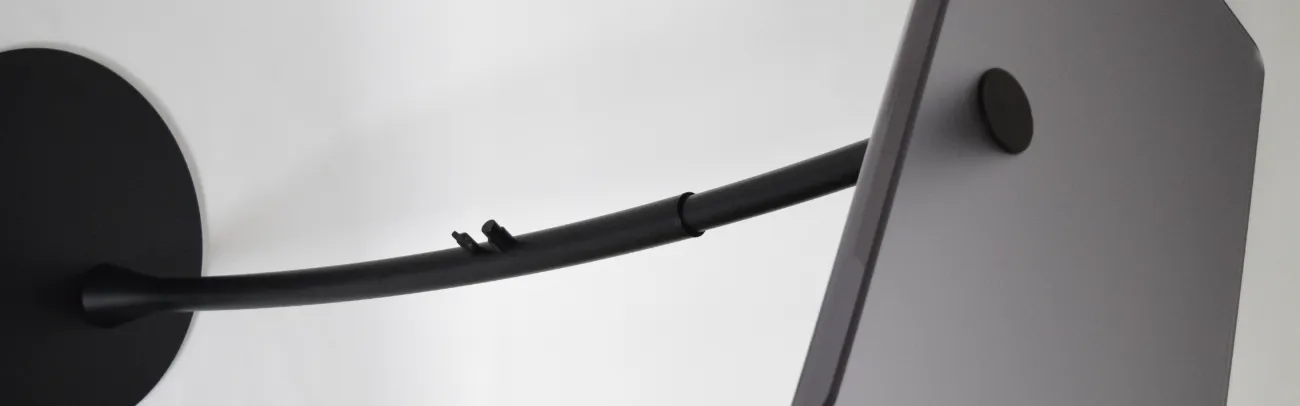
We developed a non-slip adjustment mechanism to avoid the annoying problem of the pole slipping down mid-sermon. If you have used a music stand to preach from — you may have experienced it slipping down. This mechanism needed to be reliable, even over many years of use. After much research and development, we came up with a special clicking mechanism. You loosen the wing nut, then click the stem up and down. After that you tighten the wing nut again. It is a mechanism that will still be reliable after years of use.
We re-engineered all the parts to make them as light as possible. We developed a new base to help make it stable on uneven surfaces. The result is that the Arc2 adjustable pulpit is only 2kg/4 pounds heavier than the regular Arc2.
I was volunteering at Hillsong church, designing and making furniture, shelving, special display stands, and brochure holders. A church in Canberra contacted me and asked me to design a pulpit. I designed what became the Arc1. It was what you would call a point to point design. You need a base, and a top, then join them as simply as possible. Their friends asked for one too, so I made three. Other churches asked for them too. I set up a simple website, and showed them at the Hillsong conference. It took off.
The design changed many ways as I improved it. I was able to remove 34% of the weight to make it easier to lift. I worked out a way to add anti glare film after seeing my pulpit in action for the first time at my church (Hillsong Waterloo) and being embarrassed by the reflections.
I found many customers wanted a 70cm wide top. This had never really worked well with the Arc1. It needed to be more stable and solid feeling. I needed a large base, but it needed to be light. I experimented with all sorts of bases made from layers of steel, wood, aluminium. I tried all possible combinations. I tested stem diameters and developed a test to measure rigidity (the nodding dog test). The result of this was the Arc2.
We tried 17 times to design a better lectern than the Arc2. 16 times our customers said they preferred the Arc2.
It was fruitless and exhausting. I (Stephen) finally designed a lectern shape that was great looking but was impossible to make. We spent thousands of dollars and many hours painstakingly hand making a prototype. Our customers loved it. They wanted to buy it. We had to find a way to make it at a reasonable price.
We spent 2 years of trial and error working out how to make it. It was impossible to make using conventional machines, so we had to make our own. We made machines from a metal cutting flame throwing torch, windscreen wiper motors from tractors, and more conventional parts. In the process, we had 11 suppliers say that various parts were not possible to make, produced 436 design drawings, and we set fire to a tree.
We wanted to make a lectern for educational use. Strong yet lightweight. We used triangulated aluminium construction, and curved panels to make it lightweight yet strong.
We wanted to find a way for schools to wire in microphones and lights in the simplest possible way. To do this, we included 2 Japanese made Audio Technica shock mounts. This means you can push in either 2 microphones, or a microphone and light. The shock mounts grip the body of the microphone or light (helping to stop vibrations from the lectern and stage getting into the microphone).
It has no internal wiring. You simply drop the cables through the body of the podium and connect them to your sound system. See the diagrams to see how this works.
Texture powder coat is a durable finish that resists scratches. If it does get marked, small scratches can be touched up with a black marker if need be.
You can ask a local signwriter to apply your school logo on to the front.
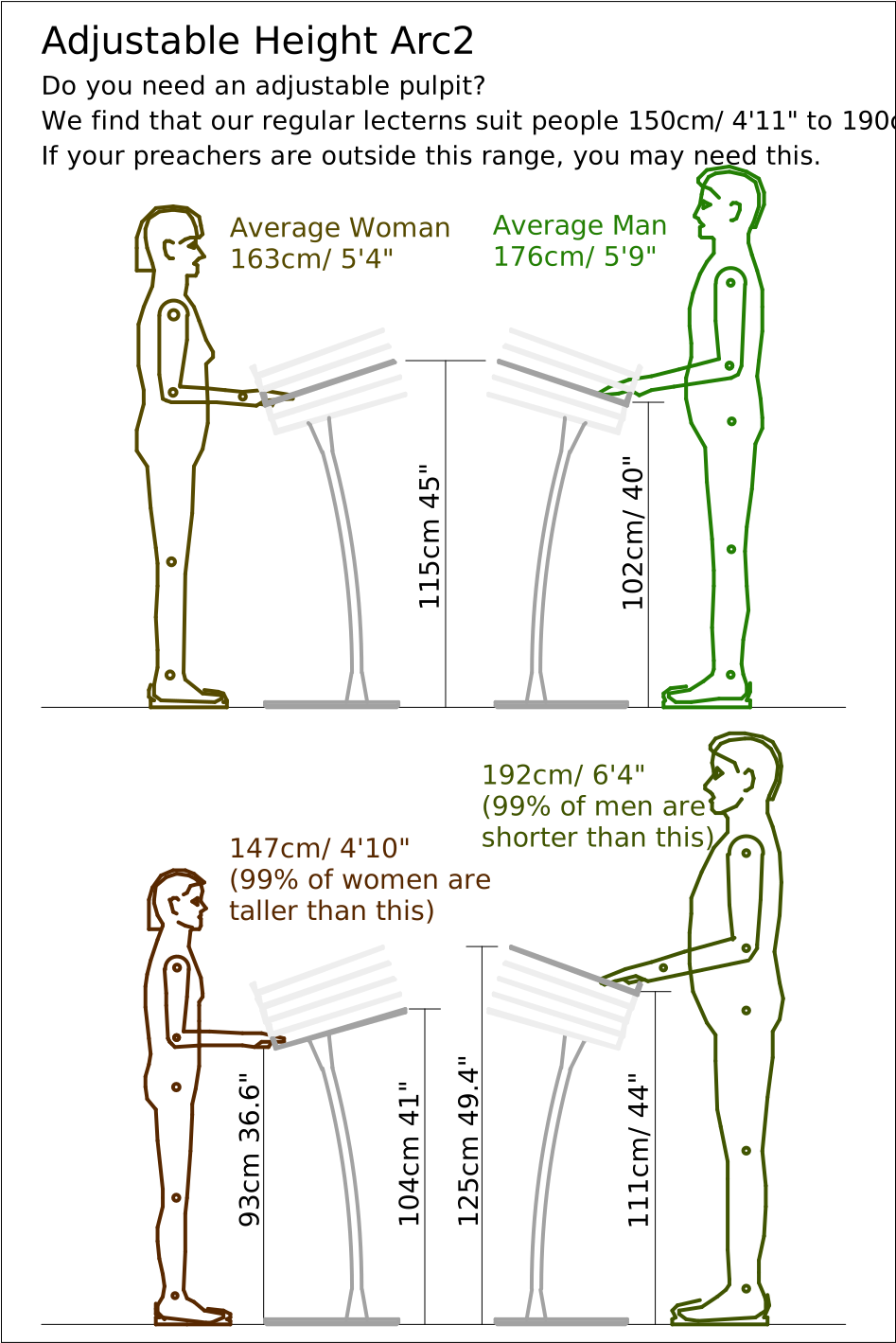
Is the height ok for our preachers?
We find that our regular lecterns suit people 150cm/ 4'11" to 190cm/ 6'3"
This diagram will help you decide.
We send to most countries. We expect it to take about a week. Most orders are sent with DHL.
| To NZ | To NZ Express | |
|---|---|---|
| NZD 0-100 order | NZD 50 | NZD 75 |
| NZD 100-500 order | NZD 70 | NZD 100 |
| NZD 500+ order | NZD 100 | NZD 150 |
| To NZ | |
|---|---|
| Standard air freight | 4-7 days |
| Express air freight | 2-4 days |
Orders are sent every Tuesday and Friday, which affects freight time — an order placed Friday afternoon may not go out until the following Tuesday. NZ customs is normally very quick, but may occasionally take extra time. Freight times are a guide only.
More detail: Shipping page ›